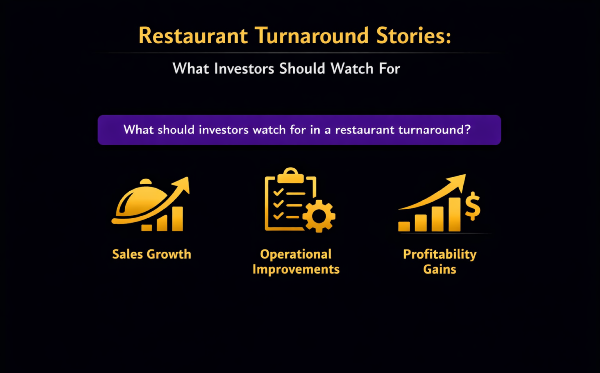
Restaurant Turnaround Stories: What Investors Should Watch For
Restaurant turnarounds can look exciting from the outside. A struggling brand suddenly reports growth. Sales improve. The stock starts to rise. It feels like a clear signal to jump in.
But here’s the problem: many investors get in too early or too late. They see headlines, not the deeper changes driving the recovery. By the time the turnaround looks obvious, much of the upside may already be gone.
At the same time, some companies look like they are improving but never truly recover. They burn cash, close stores, and lose customers again. The difference between a real turnaround and a temporary bump is not always easy to spot.
Understanding what to watch for can help investors avoid costly mistakes and find better opportunities.
Why Do Most Restaurant Turnarounds Fail?
Turnarounds are hard. Restaurants operate on thin margins. Small mistakes can erase profits.
Many chains try to fix problems by cutting costs. They reduce staff or shrink menus. This can help short-term profits, but it often hurts customer experience.
If service slows down or food quality drops, customers notice. They may not come back.
Another issue is brand damage. Once customers lose trust, it can take years to win them back.
Companies like Dine Brands (NYSE: DIN) have faced this challenge with some of their concepts. Fixing operations is one thing. Fixing perception is much harder.
What Early Signs Show a Turnaround Might Work?
The best turnarounds start before the financial results improve. Investors who wait for strong earnings often miss the early gains.
Look for changes in leadership. New executives often bring fresh strategies. They may focus on core strengths instead of chasing trends.
Menu updates are another early sign. A simpler, more focused menu can improve speed and consistency.
Store remodels also matter. A clean, modern look can attract new customers.
One detail many overlook is employee morale. Happier staff often leads to better service and repeat customers.
How Important Is Leadership in a Turnaround?
Leadership can make or break a turnaround.
When Domino’s Pizza (NYSE: DPZ) struggled years ago, new leadership made bold changes. They improved the recipe and embraced digital ordering.
That shift helped drive one of the most successful turnarounds in the industry.
Strong leaders focus on long-term value. They avoid quick fixes that damage the brand.
Investors should pay attention to management track records. Leaders with past success in similar situations often increase the odds of a real recovery.
Why Does Same-Store Sales Matter So Much?
Same-store sales show how existing locations perform. This is one of the clearest signals of a turnaround.
If sales rise at existing stores, it means customers are coming back. It also shows that changes are working.
New store openings can hide weak performance. A company may grow total revenue while older locations struggle.
Chipotle (NYSE: CMG) showed strong same-store sales growth after its food safety issues. That was a key signal that the brand was recovering.
Can Cost Cutting Hurt More Than It Helps?
Cost cutting can improve margins in the short term. But it can also create long-term problems.
Reducing staff may slow service. Cutting ingredients may hurt food quality.
Some companies cut too deep and damage their brand.
A better approach is smart cost control. This includes improving efficiency without hurting the customer experience.
For example, digital ordering can reduce labor needs while improving speed.
What Role Does Technology Play in Turnarounds?
Technology is now a major factor in restaurant success.
Mobile apps, delivery platforms, and digital payments all improve convenience.
Companies like Starbucks (NASDAQ: SBUX) have used technology to drive loyalty and repeat visits.
Digital orders also tend to have higher average ticket sizes. Customers often add more items when ordering through an app.
Some chains now use AI to improve order accuracy and predict demand.
How Do Menu Changes Signal a Real Shift?
Menus reflect strategy. A cluttered menu often leads to slow service and higher costs.
A focused menu can improve both speed and quality.
McDonald's (NYSE: MCD) simplified its menu in recent years. This helped improve operations and customer satisfaction.
Limited-time offers can also drive traffic. They create urgency and bring customers back.
However, too many promotions can confuse customers. Balance is key.
What Financial Metrics Should Investors Track Closely?
Investors should look beyond revenue growth.
Key metrics include:
Improvement across these areas signals a stronger turnaround.
Cash flow is also critical. A company needs enough cash to fund changes and survive the transition.
Key Turnaround Indicators Across Restaurant Chains
| Company |
Same-Store Sales Trend |
Margin Trend |
Digital Sales Growth |
| Domino’s (DPZ) |
Strong growth |
Improving |
High |
| Chipotle (CMG) |
Strong recovery |
Expanding |
High |
| Starbucks (SBUX) |
Moderate growth |
Stable |
Very high |
| Dine Brands (DIN) |
Mixed |
Volatile |
Moderate |
Why Do Some Brands Recover Faster Than Others?
Brand strength plays a major role.
Well-known brands have an advantage. Customers are more willing to give them another chance.
Location quality also matters. Stores in high-traffic areas recover faster.
Another factor is franchise structure. Franchise-heavy models can shift some risk away from the parent company.
Yum! Brands (NYSE: YUM) benefits from this model. Franchisees handle many day-to-day operations.
How Does Customer Perception Change During a Turnaround?
Perception can shift slowly. Customers may not notice changes right away.
Positive experiences must be consistent. One good visit is not enough.
Online reviews and social media also play a role. Good reviews can attract new customers.
Interestingly, many customers decide whether to return within the first two minutes of entering a restaurant or using the drive-thru.
Small details like cleanliness and greeting speed can have a big impact.
Can Expansion During a Turnaround Be Risky?
Expansion can be tempting. Growth stories attract investors.
But expanding too soon can stretch resources. It can also hide problems at existing locations.
A strong turnaround usually starts with fixing current stores.
Once operations improve, expansion becomes safer and more effective.
What Role Does Pricing Strategy Play?
Pricing affects both traffic and margins.
Raising prices can boost profits, but it may reduce customer visits.
Lower prices can increase traffic, but margins may shrink.
Successful turnarounds find the right balance.
Value deals often bring customers back. Over time, companies can adjust pricing as demand improves.
How Do Supply Chain Issues Impact Turnarounds?
Supply chain problems can slow progress.
Delays in ingredients or equipment can disrupt operations.
Rising food costs also pressure margins.
Companies that manage supply chains well have an advantage.
Some chains build strong supplier relationships to reduce risk.
What Risks Should Investors Watch Closely?
Turnarounds carry risk. Not all efforts succeed.
Watch for:
- Declining traffic
- Rising debt
- Frequent leadership changes
- Negative customer reviews
These can signal deeper issues.
Investors should also watch cash burn. A company running out of cash may not complete its turnaround.
Financial Snapshot of Turnaround Risks
| Risk Factor |
Impact on Business |
Investor Concern Level |
| Falling traffic |
Revenue decline |
High |
| Rising debt |
Financial stress |
High |
| Poor reviews |
Brand damage |
Medium |
| Slow innovation |
Lost competitiveness |
Medium |
Why Timing Matters More Than You Think?
Timing is critical in turnaround investing.
Buying too early can lead to losses if the turnaround fails.
Buying too late can limit gains.
Investors should look for a mix of early signs and improving metrics.
This balance helps reduce risk while capturing upside.
What Is the Long-Term Outlook for Restaurant Turnarounds?
The restaurant industry will continue to evolve.
Technology, changing tastes, and economic conditions all play a role.
Companies that adapt quickly have a better chance of success.
Turnarounds will remain common as trends shift.
Investors who understand the process can find strong opportunities.
So What Should Investors Focus On Before It’s Too Late?
The key to solving the problem from the beginning lies in knowing what truly drives a turnaround.
It is not just about cutting costs or launching new menu items. The real signals come from consistent improvements across operations, customer experience, and financial performance.
Look for rising same-store sales, better margins, and strong leadership. Watch how customers respond over time.
A true turnaround builds momentum step by step. It does not rely on one quick fix.
When you learn to spot these patterns early, you can make better investment decisions and avoid chasing headlines.
🚀 Expand Your Edge: Elite Restaurant & Consumer Insights
Ready to dominate the sector? Our Investor Intelligence Hub is designed to help you navigate the complex world of restaurant equities with precision. From deep-dive fundamental analysis to macroeconomic strategy, explore our curated silos below to find your next big winner.
🍽️ Sector Fundamentals & Top Picks
📊 Deep-Dive Financial Analysis
🧠 Strategic Operations & Economics
🌍 Macro, Risk & Global Trends
💡 Investor Psychology & Behavioral Trends
🔍 Advanced Intelligence




Restaurant Turnaround Stories: What Investors Should Watch For
Restaurant turnarounds can look exciting from the outside. A struggling brand suddenly reports growth. Sales improve. The stock starts to rise. It feels like a clear signal to jump in.
But here’s the problem: many investors get in too early or too late. They see headlines, not the deeper changes driving the recovery. By the time the turnaround looks obvious, much of the upside may already be gone.
At the same time, some companies look like they are improving but never truly recover. They burn cash, close stores, and lose customers again. The difference between a real turnaround and a temporary bump is not always easy to spot.
Understanding what to watch for can help investors avoid costly mistakes and find better opportunities.
Why Do Most Restaurant Turnarounds Fail?
Turnarounds are hard. Restaurants operate on thin margins. Small mistakes can erase profits.
Many chains try to fix problems by cutting costs. They reduce staff or shrink menus. This can help short-term profits, but it often hurts customer experience.
If service slows down or food quality drops, customers notice. They may not come back.
Another issue is brand damage. Once customers lose trust, it can take years to win them back.
Companies like Dine Brands (NYSE: DIN) have faced this challenge with some of their concepts. Fixing operations is one thing. Fixing perception is much harder.
What Early Signs Show a Turnaround Might Work?
The best turnarounds start before the financial results improve. Investors who wait for strong earnings often miss the early gains.
Look for changes in leadership. New executives often bring fresh strategies. They may focus on core strengths instead of chasing trends.
Menu updates are another early sign. A simpler, more focused menu can improve speed and consistency.
Store remodels also matter. A clean, modern look can attract new customers.
One detail many overlook is employee morale. Happier staff often leads to better service and repeat customers.
How Important Is Leadership in a Turnaround?
Leadership can make or break a turnaround.
When Domino’s Pizza (NYSE: DPZ) struggled years ago, new leadership made bold changes. They improved the recipe and embraced digital ordering.
That shift helped drive one of the most successful turnarounds in the industry.
Strong leaders focus on long-term value. They avoid quick fixes that damage the brand.
Investors should pay attention to management track records. Leaders with past success in similar situations often increase the odds of a real recovery.
Why Does Same-Store Sales Matter So Much?
Same-store sales show how existing locations perform. This is one of the clearest signals of a turnaround.
If sales rise at existing stores, it means customers are coming back. It also shows that changes are working.
New store openings can hide weak performance. A company may grow total revenue while older locations struggle.
Chipotle (NYSE: CMG) showed strong same-store sales growth after its food safety issues. That was a key signal that the brand was recovering.
Can Cost Cutting Hurt More Than It Helps?
Cost cutting can improve margins in the short term. But it can also create long-term problems.
Reducing staff may slow service. Cutting ingredients may hurt food quality.
Some companies cut too deep and damage their brand.
A better approach is smart cost control. This includes improving efficiency without hurting the customer experience.
For example, digital ordering can reduce labor needs while improving speed.
What Role Does Technology Play in Turnarounds?
Technology is now a major factor in restaurant success.
Mobile apps, delivery platforms, and digital payments all improve convenience.
Companies like Starbucks (NASDAQ: SBUX) have used technology to drive loyalty and repeat visits.
Digital orders also tend to have higher average ticket sizes. Customers often add more items when ordering through an app.
Some chains now use AI to improve order accuracy and predict demand.
How Do Menu Changes Signal a Real Shift?
Menus reflect strategy. A cluttered menu often leads to slow service and higher costs.
A focused menu can improve both speed and quality.
McDonald's (NYSE: MCD) simplified its menu in recent years. This helped improve operations and customer satisfaction.
Limited-time offers can also drive traffic. They create urgency and bring customers back.
However, too many promotions can confuse customers. Balance is key.
What Financial Metrics Should Investors Track Closely?
Investors should look beyond revenue growth.
Key metrics include:
Improvement across these areas signals a stronger turnaround.
Cash flow is also critical. A company needs enough cash to fund changes and survive the transition.
Key Turnaround Indicators Across Restaurant Chains
Why Do Some Brands Recover Faster Than Others?
Brand strength plays a major role.
Well-known brands have an advantage. Customers are more willing to give them another chance.
Location quality also matters. Stores in high-traffic areas recover faster.
Another factor is franchise structure. Franchise-heavy models can shift some risk away from the parent company.
Yum! Brands (NYSE: YUM) benefits from this model. Franchisees handle many day-to-day operations.
How Does Customer Perception Change During a Turnaround?
Perception can shift slowly. Customers may not notice changes right away.
Positive experiences must be consistent. One good visit is not enough.
Online reviews and social media also play a role. Good reviews can attract new customers.
Interestingly, many customers decide whether to return within the first two minutes of entering a restaurant or using the drive-thru.
Small details like cleanliness and greeting speed can have a big impact.
Can Expansion During a Turnaround Be Risky?
Expansion can be tempting. Growth stories attract investors.
But expanding too soon can stretch resources. It can also hide problems at existing locations.
A strong turnaround usually starts with fixing current stores.
Once operations improve, expansion becomes safer and more effective.
What Role Does Pricing Strategy Play?
Pricing affects both traffic and margins.
Raising prices can boost profits, but it may reduce customer visits.
Lower prices can increase traffic, but margins may shrink.
Successful turnarounds find the right balance.
Value deals often bring customers back. Over time, companies can adjust pricing as demand improves.
How Do Supply Chain Issues Impact Turnarounds?
Supply chain problems can slow progress.
Delays in ingredients or equipment can disrupt operations.
Rising food costs also pressure margins.
Companies that manage supply chains well have an advantage.
Some chains build strong supplier relationships to reduce risk.
What Risks Should Investors Watch Closely?
Turnarounds carry risk. Not all efforts succeed.
Watch for:
These can signal deeper issues.
Investors should also watch cash burn. A company running out of cash may not complete its turnaround.
Financial Snapshot of Turnaround Risks
Why Timing Matters More Than You Think?
Timing is critical in turnaround investing.
Buying too early can lead to losses if the turnaround fails.
Buying too late can limit gains.
Investors should look for a mix of early signs and improving metrics.
This balance helps reduce risk while capturing upside.
What Is the Long-Term Outlook for Restaurant Turnarounds?
The restaurant industry will continue to evolve.
Technology, changing tastes, and economic conditions all play a role.
Companies that adapt quickly have a better chance of success.
Turnarounds will remain common as trends shift.
Investors who understand the process can find strong opportunities.
So What Should Investors Focus On Before It’s Too Late?
The key to solving the problem from the beginning lies in knowing what truly drives a turnaround.
It is not just about cutting costs or launching new menu items. The real signals come from consistent improvements across operations, customer experience, and financial performance.
Look for rising same-store sales, better margins, and strong leadership. Watch how customers respond over time.
A true turnaround builds momentum step by step. It does not rely on one quick fix.
When you learn to spot these patterns early, you can make better investment decisions and avoid chasing headlines.
🚀 Expand Your Edge: Elite Restaurant & Consumer Insights
Ready to dominate the sector? Our Investor Intelligence Hub is designed to help you navigate the complex world of restaurant equities with precision. From deep-dive fundamental analysis to macroeconomic strategy, explore our curated silos below to find your next big winner.
🍽️ Sector Fundamentals & Top Picks
📊 Deep-Dive Financial Analysis
🧠 Strategic Operations & Economics
🌍 Macro, Risk & Global Trends
💡 Investor Psychology & Behavioral Trends
🔍 Advanced Intelligence