Last updated on April 14th 2026 by Noah Brody
🔑 Key Takeaways: Best Restaurant Growth Stocks
🚀 High-Growth Restaurant Stocks Share Proven Expansion Traits
The best restaurant growth stocks consistently combine strong brand loyalty, steady unit expansion (5%+), and rising same-store sales (3%+). Companies that scale successfully also balance revenue growth with profitability, rather than chasing sales alone. Investors should prioritize businesses that grow both top-line and bottom-line performance.
📱 Digital Ordering & Technology Are Major Growth Drivers
Digital transformation is reshaping the restaurant industry. Leading companies like Chipotle, Domino’s, and Starbucks generate 30%–70%+ of sales from digital channels, improving speed, efficiency, and customer retention. Automation, mobile apps, and loyalty programs are key indicators of long-term scalability and competitive advantage.
🌍 Global Expansion & Franchising Unlock Long-Term Scale
Top-performing restaurant stocks expand beyond domestic markets to sustain growth. Brands like McDonald’s and Yum! Brands leverage franchise-heavy models (80%–99%) to scale rapidly with lower capital risk. International presence across 50+ countries provides a long runway for continued expansion and revenue diversification.
🏆 Adaptability Is the #1 Predictor of Long-Term Winners
The biggest long-term winners are companies that continuously evolve. Successful restaurant stocks adapt through menu innovation, technology adoption, and new market entry. Businesses that rely on a single growth strategy often stall, while those that innovate consistently—like Chipotle, McDonald’s, and Domino’s—are better positioned to grow beyond the “easy wins.”
Best Restaurant Growth Stocks
Many investors buy restaurant stocks because they seem simple. People get hungry. Restaurants serve food. Money comes in. But there’s a deeper problem most investors overlook. Some restaurant companies grow fast for a few years, then hit a wall. Others grow slow at first, then explode later. The hard part is knowing which companies will keep expanding when the easy growth is gone. We’ll come back to this problem at the end.
The restaurant industry is changing fast. Digital ordering is rising. Drive‑thru lanes are getting smarter. Global expansion is speeding up. A few companies stand out because they mix strong brands with smart technology and steady store growth. These companies have the best chance to keep growing through 2026 and beyond. Investors who want a broader view of the sector often compare these names with the ones listed in the guide on fast‑growing restaurant stocks.
Why Do Some Restaurant Stocks Grow Faster Than Others?
Restaurant companies look similar from the outside. But the ones that grow the fastest usually share a few traits. They have strong brand loyalty. They open new stores at a steady pace. They use technology to speed up service. They also keep costs under control.
Many investors focus only on revenue. But revenue alone doesn’t tell the full story. A company can grow sales while losing money. The best restaurant growth stocks grow sales and profits at the same time. Some investors also compare these growth names with the most profitable restaurant stocks by margin.
| Metric |
Why It Matters |
What Strong Looks Like |
| Same‑store sales |
Shows demand at existing stores |
3%+ per year |
| Unit growth |
Measures new store openings |
5%+ per year |
| Digital sales |
Shows tech adoption |
30%+ of revenue |
| Franchise mix |
Impacts risk and margins |
80%+ franchised |
| Global reach |
Drives long‑term growth |
50+ countries |
Why Has Chipotle Grown So Fast?
Chipotle (CMG)
Chipotle keeps growing because it runs a simple menu and fast service model. Customers know what to expect. The company also uses digital ordering lanes called “Chipotlanes.” These lanes help stores serve more customers without adding much labor.
Chipotle opens hundreds of new stores each year. Most of its growth still comes from the United States. But the company has barely started expanding overseas. That gives it a long runway. Investors who follow fast‑food trends often compare Chipotle’s model with the broader fast‑food sector.
One interesting detail about Chipotle is that it doesn’t franchise its stores. Almost all locations are company‑owned. This gives Chipotle more control over quality and speed.
| Category |
Detail |
| Annual new stores |
250–300+ |
| Digital sales |
~35% |
| International presence |
Very small |
| Ownership model |
Company‑owned |
Chipotle’s main risks are food costs and labor shortages. But its brand remains strong, and demand stays high even when prices rise.
Why Does McDonald’s Keep Expanding Worldwide?
McDonald’s (MCD)
McDonald’s is one of the most recognized brands on Earth. It operates in more than 100 countries. Most of its restaurants are franchised, which keeps costs low and profits steady. This franchising strength is part of why McDonald’s often appears in lists of top franchise‑focused restaurant stocks.
The company has invested heavily in digital ordering. Its app is one of the most downloaded food apps in the world. Loyalty rewards bring customers back more often.
McDonald’s also adapts its menu to local tastes. In some countries, it sells items you won’t find in the United States. This flexibility helps it grow in new regions.
| Category |
Detail |
| Countries |
100+ |
| Franchise mix |
~95% |
| Loyalty members |
150M+ |
| Drive‑thru share |
Very high |
McDonald’s faces currency swings and global competition. But its scale and brand power make it one of the most stable restaurant stocks.
Why Does Starbucks Still Have Room to Grow?
Starbucks (SBUX)
Starbucks built a global brand around coffee culture. It sells more than drinks. It sells a place to relax, work, or meet friends. This gives it pricing power. Investors who focus on beverage‑driven restaurant stocks often compare Starbucks with other coffee‑focused names.
The company has a strong loyalty program. Members visit more often and spend more per visit. Starbucks also continues to expand in China, which is now its second‑largest market.
A surprising fact about Starbucks is that it once tried to sell music CDs in its stores. The idea didn’t last, but it shows how the company experiments with new ways to connect with customers.
| Category |
Detail |
| Global stores |
38,000+ |
| China stores |
6,000+ |
| U.S. loyalty members |
30M+ |
| Digital sales |
~50% |
Starbucks faces competition from local coffee shops. It also depends heavily on China’s economy. But its brand remains strong worldwide.
Why Do Yum! Brands’ Franchises Grow So Quickly?
Yum! Brands (YUM)
Yum! Brands owns KFC, Taco Bell, Pizza Hut, and The Habit Burger Grill. Almost all of its restaurants are franchised. This keeps costs low and helps the company expand fast.
KFC is especially strong in Asia. Taco Bell continues to grow in the United States and overseas. Pizza Hut is modernizing its delivery system. Habit Burger is still small but growing. Yum’s global footprint often overlaps with companies featured in international restaurant stock lists.
| Brand |
Global Stores |
Growth Focus |
| KFC |
28,000+ |
Asia |
| Taco Bell |
8,000+ |
U.S. and global |
| Pizza Hut |
19,000+ |
Delivery upgrades |
| Habit Burger |
350+ |
Early growth |
Yum! Brands faces competition from local chains. But its global reach gives it a strong advantage.
Why Has Domino’s Become a Tech‑Driven Pizza Leader?
Domino’s (DPZ)
Domino’s is known for pizza, but it also acts like a tech company. More than 70% of its orders come through digital channels. This helps it serve customers faster and with fewer errors.
Domino’s uses its own delivery drivers instead of third‑party apps. This gives it more control over service quality. The company also keeps its menu simple, which helps with speed and consistency.
| Category |
Detail |
| Digital orders |
70%+ |
| Global stores |
20,000+ |
| Delivery model |
In‑house |
| Franchise mix |
~99% |
Domino’s faces rising food costs and delivery competition. But its tech focus keeps it ahead of many rivals.
Why Is Restaurant Brands International Expanding So Fast?
Restaurant Brands International (QSR)
QSR owns Burger King, Popeyes, Tim Hortons, and Firehouse Subs. The company uses a franchise model that supports fast expansion.
Burger King is going through a major redesign. Popeyes continues to grow after its famous chicken sandwich boosted demand. Tim Hortons is improving its menu and digital tools. Firehouse Subs is expanding across the United States.
| Brand |
Strength |
Growth Focus |
| Burger King |
Global scale |
Remodels |
| Popeyes |
High demand |
International |
| Tim Hortons |
Canada leader |
Menu upgrades |
| Firehouse Subs |
Niche |
U.S. growth |
QSR faces competition in the chicken and burger markets. But its mix of brands gives it balance. Some investors compare QSR’s stability with restaurant stocks that hold up well during inflation!
Why Are Newer Chains Like Sweetgreen Growing So Quickly?
Sweetgreen (SG)
Sweetgreen targets customers who want healthy meals. Its stores are popular in cities and college areas. The company uses a digital‑first model that speeds up ordering.
Sweetgreen is also testing automated kitchens. These kitchens use robotics to prepare salads with less labor. This could help the company grow faster with lower costs.
| Category |
Detail |
| Store count |
~220 |
| Digital sales |
~60% |
| Automation |
Early stage |
| Target market |
Urban |
Sweetgreen is still small. It faces competition from local salad shops. But its brand appeals to younger customers.
Why Does Shake Shack Keep Attracting Younger Diners?
Shake Shack (SHAK)
Shake Shack blends fast‑casual food with a premium feel. Its stores often open in busy city areas. The company also expands overseas, especially in Asia and the Middle East.
Shake Shack uses digital kiosks and mobile ordering to speed up service. It also experiments with new menu items. One lesser‑known fact is that Shake Shack started as a hot dog cart in New York City before becoming a global chain.
| Category |
Detail |
| Global stores |
500+ |
| Digital sales |
~40% |
| International growth |
Strong |
| Brand style |
Premium |
Shake Shack faces high costs and slower traffic during economic downturns. But its brand remains popular. Some investors compare Shake Shack’s resilience with restaurant stocks that perform well during recessions.
Why Do Most Investors Miss the Real Growth Drivers?
Many investors focus on revenue or store count. But the real drivers of long‑term growth are digital adoption, global expansion, and brand loyalty. Companies that master these areas tend to grow for decades.
Digital ordering increases speed. Global expansion opens new markets. Strong brands keep customers coming back even when prices rise.
The companies in this article share these traits. But the problem from the introduction still remains: how do you know which companies will keep growing once the easy wins are gone?
So Which Restaurant Stocks Are Built for Long‑Term Growth?
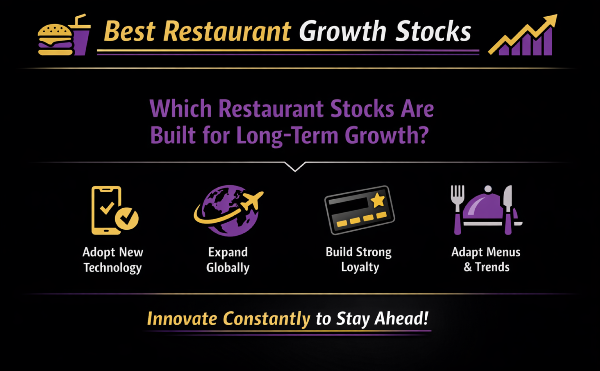
The answer lies in a simple pattern. The companies that keep growing are the ones that adapt the fastest. They use technology to improve service. They expand into new countries. They build loyalty programs that keep customers returning. They also stay flexible with their menus.
Based on these traits, the strongest long‑term restaurant growth stocks are:
- Chipotle
- McDonald’s
- Starbucks
- Domino’s
- Yum! Brands
Sweetgreen and Shake Shack offer higher risk but also higher potential reward.
The companies that solve the problem from the start — the challenge of growing after the easy growth is gone — are the ones that innovate constantly. They don’t rely on one idea. They keep evolving. That’s the real key to long‑term restaurant growth.
🔎✨ Read More: Restaurant & Food Stock Insights Hub
Stay ahead of the market with our expertly curated deep dives into high-growth food and restaurant investments. Explore the latest opportunities, trends, and analysis below:
🍽️ Restaurant Growth Leaders
🥗 Food Stock Strategy & Picks










Last updated on April 14th 2026 by Noah Brody
🔑 Key Takeaways: Best Restaurant Growth Stocks
🚀 High-Growth Restaurant Stocks Share Proven Expansion Traits
The best restaurant growth stocks consistently combine strong brand loyalty, steady unit expansion (5%+), and rising same-store sales (3%+). Companies that scale successfully also balance revenue growth with profitability, rather than chasing sales alone. Investors should prioritize businesses that grow both top-line and bottom-line performance.
📱 Digital Ordering & Technology Are Major Growth Drivers
Digital transformation is reshaping the restaurant industry. Leading companies like Chipotle, Domino’s, and Starbucks generate 30%–70%+ of sales from digital channels, improving speed, efficiency, and customer retention. Automation, mobile apps, and loyalty programs are key indicators of long-term scalability and competitive advantage.
🌍 Global Expansion & Franchising Unlock Long-Term Scale
Top-performing restaurant stocks expand beyond domestic markets to sustain growth. Brands like McDonald’s and Yum! Brands leverage franchise-heavy models (80%–99%) to scale rapidly with lower capital risk. International presence across 50+ countries provides a long runway for continued expansion and revenue diversification.
🏆 Adaptability Is the #1 Predictor of Long-Term Winners
The biggest long-term winners are companies that continuously evolve. Successful restaurant stocks adapt through menu innovation, technology adoption, and new market entry. Businesses that rely on a single growth strategy often stall, while those that innovate consistently—like Chipotle, McDonald’s, and Domino’s—are better positioned to grow beyond the “easy wins.”
Best Restaurant Growth Stocks
Many investors buy restaurant stocks because they seem simple. People get hungry. Restaurants serve food. Money comes in. But there’s a deeper problem most investors overlook. Some restaurant companies grow fast for a few years, then hit a wall. Others grow slow at first, then explode later. The hard part is knowing which companies will keep expanding when the easy growth is gone. We’ll come back to this problem at the end.
The restaurant industry is changing fast. Digital ordering is rising. Drive‑thru lanes are getting smarter. Global expansion is speeding up. A few companies stand out because they mix strong brands with smart technology and steady store growth. These companies have the best chance to keep growing through 2026 and beyond. Investors who want a broader view of the sector often compare these names with the ones listed in the guide on fast‑growing restaurant stocks.
Why Do Some Restaurant Stocks Grow Faster Than Others?
Restaurant companies look similar from the outside. But the ones that grow the fastest usually share a few traits. They have strong brand loyalty. They open new stores at a steady pace. They use technology to speed up service. They also keep costs under control.
Many investors focus only on revenue. But revenue alone doesn’t tell the full story. A company can grow sales while losing money. The best restaurant growth stocks grow sales and profits at the same time. Some investors also compare these growth names with the most profitable restaurant stocks by margin.
Why Has Chipotle Grown So Fast?
Chipotle (CMG)
Chipotle keeps growing because it runs a simple menu and fast service model. Customers know what to expect. The company also uses digital ordering lanes called “Chipotlanes.” These lanes help stores serve more customers without adding much labor.
Chipotle opens hundreds of new stores each year. Most of its growth still comes from the United States. But the company has barely started expanding overseas. That gives it a long runway. Investors who follow fast‑food trends often compare Chipotle’s model with the broader fast‑food sector.
One interesting detail about Chipotle is that it doesn’t franchise its stores. Almost all locations are company‑owned. This gives Chipotle more control over quality and speed.
Chipotle’s main risks are food costs and labor shortages. But its brand remains strong, and demand stays high even when prices rise.
Why Does McDonald’s Keep Expanding Worldwide?
McDonald’s (MCD)
McDonald’s is one of the most recognized brands on Earth. It operates in more than 100 countries. Most of its restaurants are franchised, which keeps costs low and profits steady. This franchising strength is part of why McDonald’s often appears in lists of top franchise‑focused restaurant stocks.
The company has invested heavily in digital ordering. Its app is one of the most downloaded food apps in the world. Loyalty rewards bring customers back more often.
McDonald’s also adapts its menu to local tastes. In some countries, it sells items you won’t find in the United States. This flexibility helps it grow in new regions.
McDonald’s faces currency swings and global competition. But its scale and brand power make it one of the most stable restaurant stocks.
Why Does Starbucks Still Have Room to Grow?
Starbucks (SBUX)
Starbucks built a global brand around coffee culture. It sells more than drinks. It sells a place to relax, work, or meet friends. This gives it pricing power. Investors who focus on beverage‑driven restaurant stocks often compare Starbucks with other coffee‑focused names.
The company has a strong loyalty program. Members visit more often and spend more per visit. Starbucks also continues to expand in China, which is now its second‑largest market.
A surprising fact about Starbucks is that it once tried to sell music CDs in its stores. The idea didn’t last, but it shows how the company experiments with new ways to connect with customers.
Starbucks faces competition from local coffee shops. It also depends heavily on China’s economy. But its brand remains strong worldwide.
Why Do Yum! Brands’ Franchises Grow So Quickly?
Yum! Brands (YUM)
Yum! Brands owns KFC, Taco Bell, Pizza Hut, and The Habit Burger Grill. Almost all of its restaurants are franchised. This keeps costs low and helps the company expand fast.
KFC is especially strong in Asia. Taco Bell continues to grow in the United States and overseas. Pizza Hut is modernizing its delivery system. Habit Burger is still small but growing. Yum’s global footprint often overlaps with companies featured in international restaurant stock lists.
Yum! Brands faces competition from local chains. But its global reach gives it a strong advantage.
Why Has Domino’s Become a Tech‑Driven Pizza Leader?
Domino’s (DPZ)
Domino’s is known for pizza, but it also acts like a tech company. More than 70% of its orders come through digital channels. This helps it serve customers faster and with fewer errors.
Domino’s uses its own delivery drivers instead of third‑party apps. This gives it more control over service quality. The company also keeps its menu simple, which helps with speed and consistency.
Domino’s faces rising food costs and delivery competition. But its tech focus keeps it ahead of many rivals.
Why Is Restaurant Brands International Expanding So Fast?
Restaurant Brands International (QSR)
QSR owns Burger King, Popeyes, Tim Hortons, and Firehouse Subs. The company uses a franchise model that supports fast expansion.
Burger King is going through a major redesign. Popeyes continues to grow after its famous chicken sandwich boosted demand. Tim Hortons is improving its menu and digital tools. Firehouse Subs is expanding across the United States.
QSR faces competition in the chicken and burger markets. But its mix of brands gives it balance. Some investors compare QSR’s stability with restaurant stocks that hold up well during inflation!
Why Are Newer Chains Like Sweetgreen Growing So Quickly?
Sweetgreen (SG)
Sweetgreen targets customers who want healthy meals. Its stores are popular in cities and college areas. The company uses a digital‑first model that speeds up ordering.
Sweetgreen is also testing automated kitchens. These kitchens use robotics to prepare salads with less labor. This could help the company grow faster with lower costs.
Sweetgreen is still small. It faces competition from local salad shops. But its brand appeals to younger customers.
Why Does Shake Shack Keep Attracting Younger Diners?
Shake Shack (SHAK)
Shake Shack blends fast‑casual food with a premium feel. Its stores often open in busy city areas. The company also expands overseas, especially in Asia and the Middle East.
Shake Shack uses digital kiosks and mobile ordering to speed up service. It also experiments with new menu items. One lesser‑known fact is that Shake Shack started as a hot dog cart in New York City before becoming a global chain.
Shake Shack faces high costs and slower traffic during economic downturns. But its brand remains popular. Some investors compare Shake Shack’s resilience with restaurant stocks that perform well during recessions.
Why Do Most Investors Miss the Real Growth Drivers?
Many investors focus on revenue or store count. But the real drivers of long‑term growth are digital adoption, global expansion, and brand loyalty. Companies that master these areas tend to grow for decades.
Digital ordering increases speed. Global expansion opens new markets. Strong brands keep customers coming back even when prices rise.
The companies in this article share these traits. But the problem from the introduction still remains: how do you know which companies will keep growing once the easy wins are gone?
So Which Restaurant Stocks Are Built for Long‑Term Growth?
The answer lies in a simple pattern. The companies that keep growing are the ones that adapt the fastest. They use technology to improve service. They expand into new countries. They build loyalty programs that keep customers returning. They also stay flexible with their menus.
Based on these traits, the strongest long‑term restaurant growth stocks are:
Sweetgreen and Shake Shack offer higher risk but also higher potential reward.
The companies that solve the problem from the start — the challenge of growing after the easy growth is gone — are the ones that innovate constantly. They don’t rely on one idea. They keep evolving. That’s the real key to long‑term restaurant growth.
🔎✨ Read More: Restaurant & Food Stock Insights Hub
🍽️ Restaurant Growth Leaders
🥗 Food Stock Strategy & Picks