🔑 Key Takeaways: Labor Costs and Union Negotiations in Auto Manufacturing
💰 Labor costs are a major driver of auto manufacturing profitability and stock performance
Even with automation, human labor still represents a significant portion of vehicle production costs. Rising wages, benefits, and inflation pressures can directly reduce profit margins and influence how investors value auto manufacturers.
🤝 Union negotiations can significantly impact production stability and investor confidence
Auto industry unions play a central role in setting wages, benefits, and working conditions. Negotiation outcomes can lead to stock volatility, especially when there are strike risks or major wage increases.
⚙️ The shift to electric vehicles is changing labor demand and required workforce skills
EV production reduces some traditional assembly roles but increases demand for technical, software, and battery-related skills. This transition is reshaping labor structures across the entire auto industry.
📉 Strikes, automation, and regional labor differences create long-term strategic challenges for automakers
Labor disputes can disrupt supply chains and production schedules, while automation and regional wage differences add complexity. Companies that balance automation with workforce stability are better positioned for long-term success.
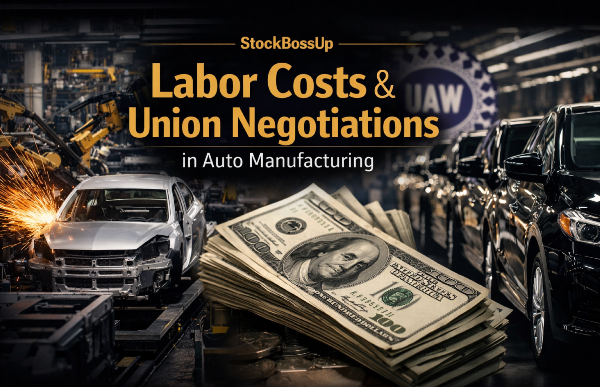
Labor Costs and Union Negotiations in Auto Manufacturing
Auto manufacturing is one of the most labor-intensive industries in the world. Even with advanced robotics and automation, human workers still play a central role in building vehicles, managing supply chains, and maintaining production quality.
The challenge for automakers is not just building cars efficiently. It is managing labor costs while maintaining stable relationships with unions. These negotiations can affect production schedules, profitability, and even stock performance.
The problem is that labor costs are rising at the same time the industry is undergoing major transformation. Electric vehicles, software systems, and global competition are changing how factories operate.
The real question is how labor negotiations will shape the future of auto manufacturing and which companies will adapt without disrupting production or profitability.
Why Are Labor Costs So Important in Auto Manufacturing?
Labor costs are a major part of total vehicle production expenses. Even in highly automated factories, skilled workers are needed for assembly, quality control, engineering support, and logistics.
Unlike many industries, auto manufacturing relies on large, concentrated workforces in specific regions. This makes labor negotiations especially important.
Small wage changes can significantly affect profit margins when scaled across millions of vehicles.
A lesser-known fact is that in some traditional auto plants, labor costs can account for more than 10% of the total cost of a vehicle, even with automation in place.
Why Do Auto Workers Belong to Strong Unions?
Auto manufacturing has a long history of unionization. Unions exist to protect worker wages, benefits, safety, and job security.
In many countries, especially in North America and parts of Europe, unions play a major role in shaping labor agreements.
Union negotiations typically cover:
- Wages and bonuses
- Healthcare and retirement benefits
- Working conditions
- Job security protections
- Plant closures and relocations
These agreements are often renegotiated every few years, which creates recurring financial planning challenges for automakers.
Why Do Union Negotiations Affect Stock Prices?
Union negotiations can directly impact auto manufacturer stock prices because they influence future costs.
Investors closely watch negotiations for signs of wage increases or strikes.
If labor costs rise significantly, profit margins may shrink. If negotiations fail, production delays can occur.
| Negotiation Outcome |
Stock Impact |
Production Impact |
Investor Sentiment |
| Wage increase only |
Moderate negative |
Stable |
Cautious |
| Strike threat |
High negative |
Disrupted |
Negative |
| Agreement reached |
Stable or positive |
Stable |
Neutral–Positive |
| Contract extension |
Positive |
Stable |
Positive |
Why Are Strikes So Disruptive to Auto Manufacturing?
Strikes are one of the most disruptive events in the auto industry. Even short strikes can halt production across multiple factories.
Because auto manufacturing relies on tightly coordinated supply chains, a shutdown in one area can affect entire production lines.
Delays can lead to lost revenue, missed delivery targets, and increased costs.
A surprising detail is that some large auto plants produce vehicles every 60 to 90 seconds during normal operation, meaning even a short shutdown can result in thousands of lost units per day.
Why Are Labor Costs Rising Across the Industry?
Labor costs are rising due to inflation, increased demand for skilled workers, and higher living costs in manufacturing regions.
Workers are also negotiating for better benefits and job security, especially as the industry shifts toward electric vehicles.
EV production requires fewer mechanical assembly tasks but more technical and software-related skills.
| Cost Factor |
Impact on Labor Costs |
Industry Effect |
| Inflation |
High |
Wage pressure |
| Skill shortages |
Medium–High |
Higher wages |
| EV transition |
Medium |
Job reshaping |
| Healthcare benefits |
High |
Increased fixed costs |
Why Are EVs Changing Labor Demand?
Electric vehicles require fewer moving parts than traditional gas-powered vehicles. This reduces some assembly work but increases demand for technical skills.
Workers are increasingly needed for:
- Battery assembly
- Software systems
- Electrical engineering
- Quality testing for EV components
This shift changes the type of labor required in factories.
It does not necessarily reduce jobs, but it changes the skill set needed.
Why Do Automakers Try to Balance Automation and Human Labor?
Automation helps reduce long-term labor costs, but it cannot fully replace human workers.
Many tasks still require flexibility, judgment, and manual precision.
Automakers must balance investment in robotics with workforce stability.
Over-automation can lead to high upfront costs, while under-automation can increase long-term labor expenses.
| Production Method |
Labor Cost Level |
Flexibility |
Investment Cost |
| Manual assembly |
High |
High |
Low |
| Semi-automated |
Medium |
Medium |
Medium |
| Fully automated |
Low |
Low |
High |
| Hybrid systems |
Balanced |
High |
Medium–High |
Why Are Union Negotiations Becoming More Complex?
Union negotiations are becoming more complex due to industry transformation.
Workers are not only negotiating wages but also job security in a changing industry.
Key topics now include:
- EV transition job guarantees
- Retraining programs
- Automation impact protections
- Remote software-related roles
This expands the scope of negotiations beyond traditional wage discussions.
Why Do Labor Agreements Differ by Region?
Labor agreements vary significantly by region due to differences in labor laws, union strength, and economic conditions.
Some countries have strong centralized unions, while others have more flexible labor markets.
This affects where automakers choose to build factories.
| Region |
Union Strength |
Labor Cost Level |
Flexibility |
| North America |
High |
High |
Medium |
| Europe |
High |
Medium–High |
Medium |
| Asia (varies) |
Low–Medium |
Low–Medium |
High |
| Emerging markets |
Low |
Low |
Very High |
Why Are Labor Disputes Linked to Supply Chain Risk?
Labor disputes can disrupt supply chains quickly. Since auto manufacturing depends on just-in-time production, even small delays can ripple through the system.
If one plant stops production, suppliers and assembly plants downstream are also affected.
This creates financial pressure beyond the factory where the dispute occurs.
Why Are Workers Concerned About Automation?
Workers are increasingly concerned about automation replacing traditional roles.
While automation improves efficiency, it can reduce demand for certain types of labor.
Unions often negotiate protections to ensure workers are retrained or reassigned rather than eliminated.
A unique trend is that some automakers now include formal retraining guarantees in labor contracts to help workers transition into EV and software-related roles.
Why Do Labor Costs Matter More in Electric Vehicle Production?
Electric vehicle production changes the structure of labor costs.
EVs have fewer mechanical parts but require more specialized assembly and technical work.
This shifts labor from volume-based assembly to skill-based production.
It also increases demand for engineering and software expertise within manufacturing plants.
Why Are Long-Term Labor Agreements Important?
Long-term labor agreements help stabilize production and reduce uncertainty.
They allow automakers to plan costs, production schedules, and investment strategies more effectively.
However, long-term agreements can also reduce flexibility during rapid industry change.
Why Do Investors Track Labor Negotiations Closely?
Investors track labor negotiations because they directly affect profitability and production stability.
Wage increases or strikes can quickly impact earnings forecasts.
Labor stability is often seen as a sign of strong operational management.
What Is the Real Long-Term Impact of Labor Costs on Auto Manufacturing?
The long-term impact of labor costs and union negotiations is a shift in how the industry operates.
Auto manufacturing is moving toward a more balanced model that combines automation, skilled labor, and digital systems.
Labor will remain essential, but the type of labor will continue to evolve.
The solution is not eliminating labor but adapting workforce skills to match new technology.
In the end, companies that manage labor relations effectively will have a competitive advantage in both production stability and long-term profitability.

















🔑 Key Takeaways: Labor Costs and Union Negotiations in Auto Manufacturing
💰 Labor costs are a major driver of auto manufacturing profitability and stock performance
Even with automation, human labor still represents a significant portion of vehicle production costs. Rising wages, benefits, and inflation pressures can directly reduce profit margins and influence how investors value auto manufacturers.
🤝 Union negotiations can significantly impact production stability and investor confidence
Auto industry unions play a central role in setting wages, benefits, and working conditions. Negotiation outcomes can lead to stock volatility, especially when there are strike risks or major wage increases.
⚙️ The shift to electric vehicles is changing labor demand and required workforce skills
EV production reduces some traditional assembly roles but increases demand for technical, software, and battery-related skills. This transition is reshaping labor structures across the entire auto industry.
📉 Strikes, automation, and regional labor differences create long-term strategic challenges for automakers
Labor disputes can disrupt supply chains and production schedules, while automation and regional wage differences add complexity. Companies that balance automation with workforce stability are better positioned for long-term success.
Labor Costs and Union Negotiations in Auto Manufacturing
Auto manufacturing is one of the most labor-intensive industries in the world. Even with advanced robotics and automation, human workers still play a central role in building vehicles, managing supply chains, and maintaining production quality.
The challenge for automakers is not just building cars efficiently. It is managing labor costs while maintaining stable relationships with unions. These negotiations can affect production schedules, profitability, and even stock performance.
The problem is that labor costs are rising at the same time the industry is undergoing major transformation. Electric vehicles, software systems, and global competition are changing how factories operate.
The real question is how labor negotiations will shape the future of auto manufacturing and which companies will adapt without disrupting production or profitability.
Why Are Labor Costs So Important in Auto Manufacturing?
Labor costs are a major part of total vehicle production expenses. Even in highly automated factories, skilled workers are needed for assembly, quality control, engineering support, and logistics.
Unlike many industries, auto manufacturing relies on large, concentrated workforces in specific regions. This makes labor negotiations especially important.
Small wage changes can significantly affect profit margins when scaled across millions of vehicles.
A lesser-known fact is that in some traditional auto plants, labor costs can account for more than 10% of the total cost of a vehicle, even with automation in place.
Why Do Auto Workers Belong to Strong Unions?
Auto manufacturing has a long history of unionization. Unions exist to protect worker wages, benefits, safety, and job security.
In many countries, especially in North America and parts of Europe, unions play a major role in shaping labor agreements.
Union negotiations typically cover:
These agreements are often renegotiated every few years, which creates recurring financial planning challenges for automakers.
Why Do Union Negotiations Affect Stock Prices?
Union negotiations can directly impact auto manufacturer stock prices because they influence future costs.
Investors closely watch negotiations for signs of wage increases or strikes.
If labor costs rise significantly, profit margins may shrink. If negotiations fail, production delays can occur.
Why Are Strikes So Disruptive to Auto Manufacturing?
Strikes are one of the most disruptive events in the auto industry. Even short strikes can halt production across multiple factories.
Because auto manufacturing relies on tightly coordinated supply chains, a shutdown in one area can affect entire production lines.
Delays can lead to lost revenue, missed delivery targets, and increased costs.
A surprising detail is that some large auto plants produce vehicles every 60 to 90 seconds during normal operation, meaning even a short shutdown can result in thousands of lost units per day.
Why Are Labor Costs Rising Across the Industry?
Labor costs are rising due to inflation, increased demand for skilled workers, and higher living costs in manufacturing regions.
Workers are also negotiating for better benefits and job security, especially as the industry shifts toward electric vehicles.
EV production requires fewer mechanical assembly tasks but more technical and software-related skills.
Why Are EVs Changing Labor Demand?
Electric vehicles require fewer moving parts than traditional gas-powered vehicles. This reduces some assembly work but increases demand for technical skills.
Workers are increasingly needed for:
This shift changes the type of labor required in factories.
It does not necessarily reduce jobs, but it changes the skill set needed.
Why Do Automakers Try to Balance Automation and Human Labor?
Automation helps reduce long-term labor costs, but it cannot fully replace human workers.
Many tasks still require flexibility, judgment, and manual precision.
Automakers must balance investment in robotics with workforce stability.
Over-automation can lead to high upfront costs, while under-automation can increase long-term labor expenses.
Why Are Union Negotiations Becoming More Complex?
Union negotiations are becoming more complex due to industry transformation.
Workers are not only negotiating wages but also job security in a changing industry.
Key topics now include:
This expands the scope of negotiations beyond traditional wage discussions.
Why Do Labor Agreements Differ by Region?
Labor agreements vary significantly by region due to differences in labor laws, union strength, and economic conditions.
Some countries have strong centralized unions, while others have more flexible labor markets.
This affects where automakers choose to build factories.
Why Are Labor Disputes Linked to Supply Chain Risk?
Labor disputes can disrupt supply chains quickly. Since auto manufacturing depends on just-in-time production, even small delays can ripple through the system.
If one plant stops production, suppliers and assembly plants downstream are also affected.
This creates financial pressure beyond the factory where the dispute occurs.
Why Are Workers Concerned About Automation?
Workers are increasingly concerned about automation replacing traditional roles.
While automation improves efficiency, it can reduce demand for certain types of labor.
Unions often negotiate protections to ensure workers are retrained or reassigned rather than eliminated.
A unique trend is that some automakers now include formal retraining guarantees in labor contracts to help workers transition into EV and software-related roles.
Why Do Labor Costs Matter More in Electric Vehicle Production?
Electric vehicle production changes the structure of labor costs.
EVs have fewer mechanical parts but require more specialized assembly and technical work.
This shifts labor from volume-based assembly to skill-based production.
It also increases demand for engineering and software expertise within manufacturing plants.
Why Are Long-Term Labor Agreements Important?
Long-term labor agreements help stabilize production and reduce uncertainty.
They allow automakers to plan costs, production schedules, and investment strategies more effectively.
However, long-term agreements can also reduce flexibility during rapid industry change.
Why Do Investors Track Labor Negotiations Closely?
Investors track labor negotiations because they directly affect profitability and production stability.
Wage increases or strikes can quickly impact earnings forecasts.
Labor stability is often seen as a sign of strong operational management.
What Is the Real Long-Term Impact of Labor Costs on Auto Manufacturing?
The long-term impact of labor costs and union negotiations is a shift in how the industry operates.
Auto manufacturing is moving toward a more balanced model that combines automation, skilled labor, and digital systems.
Labor will remain essential, but the type of labor will continue to evolve.
The solution is not eliminating labor but adapting workforce skills to match new technology.
In the end, companies that manage labor relations effectively will have a competitive advantage in both production stability and long-term profitability.