Why Do Most Drivers Misjudge Which Automakers Lead in Charging?
Many drivers assume the biggest EV brands have the biggest charging networks. But charging infrastructure depends on more than vehicle sales. It depends on partnerships, grid access, and long‑term investment.
Some automakers build their own fast‑charging networks. Others rely on third‑party providers. Some focus on home charging. Others focus on highway corridors.
This creates confusion. A company may sell many EVs but offer few chargers. Another may sell fewer EVs but operate a massive charging network.
Common Belief Reality
Tesla has the only fast network Several automakers now match or exceed regional coverage
More EV sales = more chargers Some high‑volume brands rely on partners
Charging is the same everywhere Speed and reliability vary widely
Understanding these differences helps reveal which companies truly lead.
Why Does Tesla Still Operate the Most Powerful Fast‑Charging Network?
Tesla operates the largest fast‑charging network in the world. Its Supercharger system includes more than 55,000 chargers globally.
Tesla’s advantage comes from early investment. It built chargers before most automakers even launched EVs.
Superchargers offer consistent speeds, simple interfaces, and high reliability. Many stations support 250 kW charging, and new V4 units exceed that.
Tesla also opened its network to other automakers. Ford, GM, Rivian, and others now use Tesla’s NACS connector. This expands access and increases utilization.
One unique detail: Tesla’s Superchargers have higher uptime than many public networks, often exceeding 99% availability.
Why Are BYD and Chinese Automakers Expanding Charging Faster Than Anyone?
China has the world’s largest EV charging ecosystem. BYD, SAIC, Geely, and NIO all contribute to rapid expansion.
BYD partners with State Grid and private operators to support millions of EVs.
Geely builds chargers for its brands, including Zeekr and Lynk & Co.
SAIC supports large charging hubs in major cities.
China’s charging network includes more than 2.2 million public chargers, far more than any other country.
Automakers benefit from government support and dense urban planning.
Below is a comparison of major Chinese automakers and their charging strategies:
markdown
| Automaker | Charging Strategy | Key Advantage |
|-----------|-------------------|---------------|
| BYD | Partnerships with State Grid | Massive national coverage |
| NIO | Battery‑swap stations | 3‑minute energy replacement |
| Geely | Brand‑specific networks | Integrated with exports |
| SAIC | Urban fast‑charging hubs | High‑density regions |
NIO’s battery‑swap system is especially notable. Drivers can replace a depleted battery in minutes, avoiding long charging times.
Why Does NIO Stand Out With Its Battery‑Swap Network?
NIO operates more than 2,300 battery‑swap stations across China and Europe.
These stations replace a battery in about 3 minutes, faster than most gas fill‑ups.
NIO’s system reduces battery wear and allows drivers to upgrade to newer packs without buying a new car.
This model solves range anxiety in a unique way. Instead of waiting for a charge, drivers simply swap and go.
One interesting fact: NIO’s swap stations perform more than 60,000 swaps per day, showing how popular the system has become.
Why Are Hyundai and Kia Expanding Charging Through Global Partnerships?
Hyundai and Kia do not operate their own global network. Instead, they partner with major charging providers.
In the U.S., they work with Electrify America and ChargePoint.
In Europe, they partner with IONITY, a joint venture that includes BMW, Ford, Mercedes‑Benz, and Volkswagen.
IONITY operates more than 3,000 fast chargers across Europe, with speeds up to 350 kW.
Hyundai’s E‑GMP platform supports ultra‑fast charging, making these stations especially effective.
Below is a comparison of partnership‑driven charging networks:
markdown
| Automaker | Primary Network | Max Speed |
|-----------|------------------|-----------|
| Hyundai | IONITY | 350 kW |
| Kia | Electrify America | 350 kW |
| Ford | Tesla Supercharger | 250–350 kW |
| GM | Tesla Supercharger | 250–350 kW |
Partnerships allow these automakers to scale quickly without building their own networks.
Why Are Ford and GM Shifting to Tesla’s Charging Standard?
Ford and GM announced major shifts to Tesla’s NACS connector.
This gives their drivers access to thousands of Superchargers.
It also simplifies charging for future EVs.
Ford and GM still support other networks, but NACS access gives them a major advantage.
Drivers gain access to reliable fast charging without waiting for new stations to be built.
This shift also pushes the industry toward a unified charging standard.
Why Does Volkswagen Lead Europe’s Charging Expansion?
Volkswagen is a founding member of IONITY, Europe’s largest high‑speed charging network.
IONITY operates stations across major highways, enabling long‑distance travel.
Volkswagen also invests in Elli, its energy and charging subsidiary.
Elli manages home chargers, public chargers, and energy services.
This gives Volkswagen a full ecosystem, from home charging to highway travel.
Below is a comparison of European charging leaders:
markdown
| Automaker | Charging Network | Coverage |
|-----------|------------------|----------|
| Volkswagen | IONITY + Elli | Europe‑wide |
| Mercedes‑Benz | IONITY | Europe‑wide |
| BMW | IONITY | Europe‑wide |
| Renault | Public partnerships | Regional |
Volkswagen’s multi‑layered approach gives it strong control over charging infrastructure.
Why Does the Real Answer to “Who Has the Most Charging Infrastructure?” Depend on Strategy?
Charging leadership depends on more than the number of stations.
Tesla leads in fast‑charging reliability.
BYD and Chinese automakers lead in total coverage.
NIO leads in battery‑swap innovation.
Hyundai, Kia, Ford, and GM lead in partnerships.
Volkswagen leads in European expansion.
Each strategy solves a different part of the charging challenge.
markdown
| Leader | Strength | Key Region |
|--------|-----------|-------------|
| Tesla | Fast‑charging network | Global |
| BYD | Public charging access | China |
| NIO | Battery‑swap stations | China + Europe |
| Hyundai/Kia | Partnership networks | U.S. + Europe |
| Volkswagen | IONITY + Elli | Europe |
The solution to the problem introduced at the start is not to look at the number of chargers alone. It is to understand which automakers build networks that are reliable, fast, and easy to use. These companies — Tesla, BYD, NIO, Hyundai, Kia, and Volkswagen — shape the future of EV charging.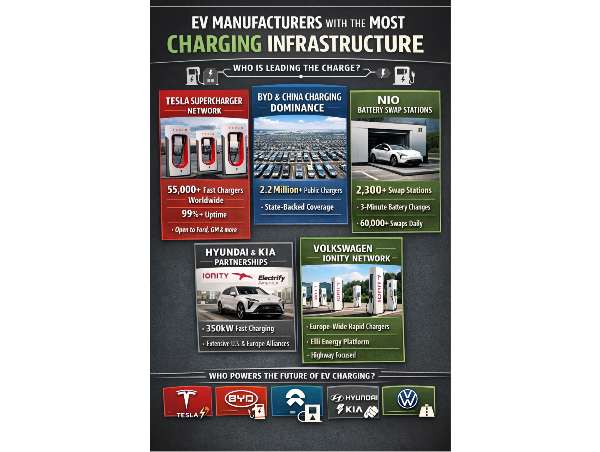





Why Do Most Drivers Misjudge Which Automakers Lead in Charging? Many drivers assume the biggest EV brands have the biggest charging networks. But charging infrastructure depends on more than vehicle sales. It depends on partnerships, grid access, and long‑term investment. Some automakers build their own fast‑charging networks. Others rely on third‑party providers. Some focus on home charging. Others focus on highway corridors.
This creates confusion. A company may sell many EVs but offer few chargers. Another may sell fewer EVs but operate a massive charging network.
Common Belief Reality Tesla has the only fast network Several automakers now match or exceed regional coverage More EV sales = more chargers Some high‑volume brands rely on partners Charging is the same everywhere Speed and reliability vary widely
Understanding these differences helps reveal which companies truly lead.
Why Does Tesla Still Operate the Most Powerful Fast‑Charging Network? Tesla operates the largest fast‑charging network in the world. Its Supercharger system includes more than 55,000 chargers globally. Tesla’s advantage comes from early investment. It built chargers before most automakers even launched EVs. Superchargers offer consistent speeds, simple interfaces, and high reliability. Many stations support 250 kW charging, and new V4 units exceed that.
Tesla also opened its network to other automakers. Ford, GM, Rivian, and others now use Tesla’s NACS connector. This expands access and increases utilization.
One unique detail: Tesla’s Superchargers have higher uptime than many public networks, often exceeding 99% availability.
Why Are BYD and Chinese Automakers Expanding Charging Faster Than Anyone? China has the world’s largest EV charging ecosystem. BYD, SAIC, Geely, and NIO all contribute to rapid expansion. BYD partners with State Grid and private operators to support millions of EVs. Geely builds chargers for its brands, including Zeekr and Lynk & Co. SAIC supports large charging hubs in major cities.
China’s charging network includes more than 2.2 million public chargers, far more than any other country. Automakers benefit from government support and dense urban planning.
Below is a comparison of major Chinese automakers and their charging strategies:
markdown | Automaker | Charging Strategy | Key Advantage | |-----------|-------------------|---------------| | BYD | Partnerships with State Grid | Massive national coverage | | NIO | Battery‑swap stations | 3‑minute energy replacement | | Geely | Brand‑specific networks | Integrated with exports | | SAIC | Urban fast‑charging hubs | High‑density regions | NIO’s battery‑swap system is especially notable. Drivers can replace a depleted battery in minutes, avoiding long charging times.
Why Does NIO Stand Out With Its Battery‑Swap Network? NIO operates more than 2,300 battery‑swap stations across China and Europe. These stations replace a battery in about 3 minutes, faster than most gas fill‑ups. NIO’s system reduces battery wear and allows drivers to upgrade to newer packs without buying a new car.
This model solves range anxiety in a unique way. Instead of waiting for a charge, drivers simply swap and go.
One interesting fact: NIO’s swap stations perform more than 60,000 swaps per day, showing how popular the system has become.
Why Are Hyundai and Kia Expanding Charging Through Global Partnerships? Hyundai and Kia do not operate their own global network. Instead, they partner with major charging providers. In the U.S., they work with Electrify America and ChargePoint. In Europe, they partner with IONITY, a joint venture that includes BMW, Ford, Mercedes‑Benz, and Volkswagen.
IONITY operates more than 3,000 fast chargers across Europe, with speeds up to 350 kW. Hyundai’s E‑GMP platform supports ultra‑fast charging, making these stations especially effective.
Below is a comparison of partnership‑driven charging networks:
markdown | Automaker | Primary Network | Max Speed | |-----------|------------------|-----------| | Hyundai | IONITY | 350 kW | | Kia | Electrify America | 350 kW | | Ford | Tesla Supercharger | 250–350 kW | | GM | Tesla Supercharger | 250–350 kW | Partnerships allow these automakers to scale quickly without building their own networks.
Why Are Ford and GM Shifting to Tesla’s Charging Standard? Ford and GM announced major shifts to Tesla’s NACS connector. This gives their drivers access to thousands of Superchargers. It also simplifies charging for future EVs.
Ford and GM still support other networks, but NACS access gives them a major advantage. Drivers gain access to reliable fast charging without waiting for new stations to be built.
This shift also pushes the industry toward a unified charging standard.
Why Does Volkswagen Lead Europe’s Charging Expansion? Volkswagen is a founding member of IONITY, Europe’s largest high‑speed charging network. IONITY operates stations across major highways, enabling long‑distance travel. Volkswagen also invests in Elli, its energy and charging subsidiary.
Elli manages home chargers, public chargers, and energy services. This gives Volkswagen a full ecosystem, from home charging to highway travel.
Below is a comparison of European charging leaders:
markdown | Automaker | Charging Network | Coverage | |-----------|------------------|----------| | Volkswagen | IONITY + Elli | Europe‑wide | | Mercedes‑Benz | IONITY | Europe‑wide | | BMW | IONITY | Europe‑wide | | Renault | Public partnerships | Regional | Volkswagen’s multi‑layered approach gives it strong control over charging infrastructure.
Why Does the Real Answer to “Who Has the Most Charging Infrastructure?” Depend on Strategy? Charging leadership depends on more than the number of stations. Tesla leads in fast‑charging reliability. BYD and Chinese automakers lead in total coverage. NIO leads in battery‑swap innovation. Hyundai, Kia, Ford, and GM lead in partnerships. Volkswagen leads in European expansion.
Each strategy solves a different part of the charging challenge.
markdown | Leader | Strength | Key Region | |--------|-----------|-------------| | Tesla | Fast‑charging network | Global | | BYD | Public charging access | China | | NIO | Battery‑swap stations | China + Europe | | Hyundai/Kia | Partnership networks | U.S. + Europe | | Volkswagen | IONITY + Elli | Europe | The solution to the problem introduced at the start is not to look at the number of chargers alone. It is to understand which automakers build networks that are reliable, fast, and easy to use. These companies — Tesla, BYD, NIO, Hyundai, Kia, and Volkswagen — shape the future of EV charging.