What Are Consumer Discretionary Stocks?
Consumer discretionary stocks represent companies that sell goods and services people buy when they have extra income. These purchases are not essential for daily living. They include things like new clothes, vacations, entertainment, and luxury items. When the economy is strong, people tend to spend more on these categories. When the economy weakens, spending often declines.
This sector is one of the most sensitive to economic cycles. Investors watch it closely because it often signals how confident consumers feel about their financial future. When consumers are optimistic, discretionary companies usually benefit. When consumers pull back, these businesses feel the impact quickly.
Understanding how this sector works can help investors make informed decisions. It also helps explain why certain companies thrive during expansions and struggle during downturns.
Understanding the Consumer Discretionary Sector
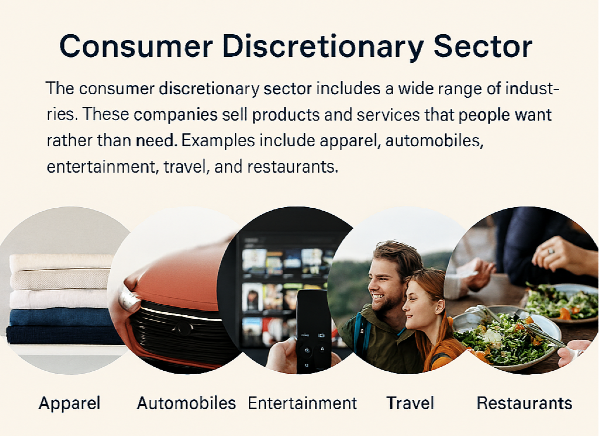
The consumer discretionary sector includes a wide range of industries. These companies sell products and services that people want rather than need. Examples include apparel, automobiles, entertainment, travel, and restaurants.
This sector differs from consumer staples. Staples include essential items like food, household goods, and personal care products. Demand for staples remains steady even during recessions. Discretionary demand rises and falls with economic conditions.
The sector is diverse. It includes global brands, niche retailers, and innovative technology-driven companies. Many of the world’s most recognized companies fall into this category.
What the Sector Includes
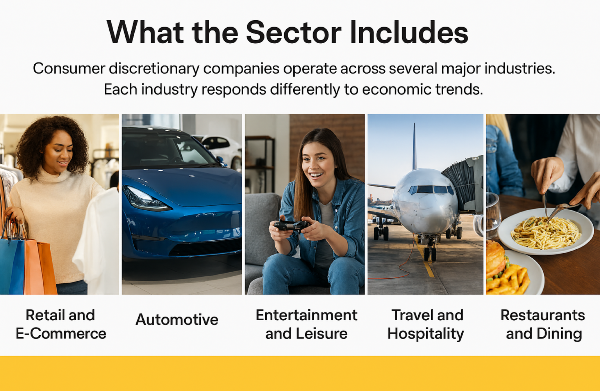
Consumer discretionary companies operate across several major industries. Each industry responds differently to economic trends.
For example, during periods of economic growth, luxury retailers and travel companies often see a surge in demand as consumers feel more confident and spend freely. In contrast, during economic downturns, these same industries may experience sharp declines, while fast-food chains or budget-friendly retailers might remain relatively stable or even grow as consumers seek more affordable options. The automotive industry, particularly new car sales, tends to be highly sensitive to interest rates and consumer credit availability, making it vulnerable when borrowing costs rise.
Entertainment and leisure companies, such as streaming platforms or gaming firms, may show resilience during mild recessions as consumers shift toward affordable at-home experiences. However, theme parks and live event businesses typically suffer when discretionary income tightens. Restaurants also vary—fine dining may decline during economic stress, while quick-service chains often maintain steady traffic. These differences highlight the importance of understanding sub-sector dynamics when evaluating consumer discretionary investments, as not all companies within the sector will perform the same under changing economic conditions.
Retail and E‑Commerce
Retailers in the consumer discretionary sector offer a wide variety of non-essential goods, including clothing, footwear, luxury items, and household products. These purchases are often influenced by trends, seasons, and consumer sentiment. Traditional brick-and-mortar stores still play a role, especially in experiential shopping, but they face increasing competition from digital-first brands. As consumer preferences evolve, retailers must adapt quickly to changing styles, sustainability concerns, and personalized shopping experiences.
E-commerce companies have become dominant players in this space, reshaping how consumers browse and buy. Online shopping continues to grow due to its convenience, broader selection, and competitive pricing. Platforms like Amazon, Shopify, and niche direct-to-consumer brands have accelerated this shift. Mobile commerce, AI-driven recommendations, and fast delivery options further reinforce digital adoption. As technology advances, retailers that embrace innovation and data-driven strategies are better positioned to capture market share and build customer loyalty.
Automotive
The automotive segment within the consumer discretionary sector encompasses a broad range of businesses, including electric vehicle (EV) manufacturers, legacy automakers, and suppliers of parts and components. EV companies are driving innovation with cutting-edge technologies and sustainability-focused designs, while traditional automakers continue to evolve by investing in hybrid models and autonomous driving capabilities. Parts suppliers play a critical role in supporting both new and existing vehicle production, making them essential to the industry's overall ecosystem.
Consumer demand for vehicles is closely tied to macroeconomic conditions. Interest rates significantly influence affordability, as higher rates increase the cost of financing through auto loans. Likewise, consumer confidence plays a pivotal role—when individuals feel secure in their financial outlook, they are more likely to make large purchases like cars. During periods of economic uncertainty or rising borrowing costs, vehicle sales often decline, making the automotive industry particularly sensitive to shifts in the broader economy.
Entertainment and Leisure
The entertainment and leisure segment of the consumer discretionary sector encompasses a wide variety of businesses, including streaming platforms, video game developers, theme parks, and sports entertainment companies. These industries cater to consumers seeking enjoyment, relaxation, and immersive experiences. Streaming services and gaming companies thrive on digital engagement, while theme parks and sports venues rely on physical attendance and event-driven revenue. Each sub-sector offers unique opportunities for growth, often driven by technological innovation and evolving consumer preferences.
What unites these businesses is their reliance on discretionary income and available leisure time. Consumers are more likely to spend on entertainment when they feel financially secure and have time to enjoy these offerings. During economic expansions, demand for subscriptions, games, travel to theme parks, and live sports events tends to rise. Conversely, in periods of financial strain or uncertainty, spending on entertainment often declines, making this category highly sensitive to shifts in consumer sentiment and broader economic conditions.
Travel and Hospitality
The travel and hospitality segment includes airlines, hotels, and digital booking platforms that help consumers plan and manage their trips. Airlines provide transportation for both leisure and business travelers, while hotels offer accommodations ranging from budget-friendly rooms to luxury resorts. Booking platforms connect these services, making it easier for travelers to compare prices, read reviews, and secure reservations. Together, these businesses form a global network that supports tourism, business travel, and the broader experience economy.
Demand in this category is closely tied to the overall health of the economy. When economic conditions are strong and consumers feel financially secure, travel spending typically increases as people book vacations, attend events, and explore new destinations. During downturns, however, discretionary travel is often one of the first expenses households cut back on. As a result, airlines, hotels, and booking services tend to experience noticeable declines in revenue during periods of uncertainty, making the sector highly sensitive to shifts in consumer confidence and economic cycles.
Restaurants and Dining
The restaurant and dining segment spans a wide spectrum of businesses, from quick-service fast‑food chains to upscale fine‑dining establishments. Fast‑food restaurants focus on convenience, affordability, and speed, while casual and premium dining experiences emphasize atmosphere, service quality, and culinary creativity. This diversity allows the industry to serve a broad range of consumer needs, whether someone is grabbing a quick meal on the go or celebrating a special occasion with a multi‑course dinner.
Shifts in consumer preferences play a major role in shaping this sector. Changes in income levels often influence where people choose to eat, with higher disposable income leading to increased spending on premium dining experiences. Lifestyle trends—such as health consciousness, interest in global cuisines, or demand for delivery and mobile ordering—also drive restaurant innovation. As these preferences evolve, businesses must adapt quickly to stay relevant and competitive in a dynamic market.
| Industry |
Examples |
Notes |
| Retail & E‑Commerce |
Apparel, luxury goods, online marketplaces |
Highly competitive and trend-driven |
| Automotive |
EV makers, dealerships, parts suppliers |
Sensitive to interest rates |
| Entertainment |
Streaming, gaming, theme parks |
Dependent on consumer free time |
| Travel & Hospitality |
Airlines, hotels, booking sites |
Strongly tied to economic cycles |
| Restaurants |
Fast food, casual dining, premium dining |
Influenced by consumer income |
Examples of Consumer Discretionary Industries
How Consumer Discretionary Differs From Consumer Staples
Consumer staples include essential goods. These are products people buy regardless of economic conditions. Examples include groceries, cleaning supplies, and personal hygiene items.
Discretionary goods are optional. People buy them when they feel financially secure. This makes discretionary stocks more volatile. They rise quickly during expansions and fall sharply during recessions.
Staples tend to be defensive investments. Discretionary stocks are cyclical. Investors often shift between these sectors depending on market conditions.
Key Macroeconomic Indicators That Affect the Sector
Several economic factors influence discretionary spending:
- Consumer confidence
- Interest rates
- Inflation
- Wage growth
- GDP growth
When confidence is high, consumers feel comfortable making large purchases. When interest rates rise, borrowing becomes more expensive. This affects auto loans, credit card spending, and home improvement projects.
Inflation can reduce purchasing power. Wage growth can offset inflation, but only if wages rise fast enough. GDP growth reflects the overall health of the economy.
Why the Sector Is Considered Cyclical
A cyclical sector rises and falls with economic cycles. Consumer discretionary stocks fit this definition. They perform well during expansions and struggle during contractions.
Consumers cut back on non-essential spending during recessions. This affects retailers, automakers, travel companies, and entertainment providers. When the economy recovers, spending rebounds.
This cyclical nature creates opportunities for investors who understand economic trends.
Table: Economic Conditions and Sector Performance
| Economic Condition |
Expected Consumer Behavior |
Sector Impact |
| Strong Economy |
Higher spending |
Positive |
| Recession |
Reduced spending |
Negative |
| Rising Interest Rates |
Lower borrowing |
Mixed/Negative |
| High Consumer Confidence |
Increased purchases |
Positive |
| High Inflation |
Reduced purchasing power |
Negative |
Economic Conditions and Consumer Discretionary Performance
How to Evaluate Consumer Discretionary Stocks

Evaluating consumer discretionary stocks means looking at both the numbers and the story behind the company. Start with basic financial metrics like revenue growth, earnings per share, profit margins, and how much debt the company carries. These numbers help you understand whether the business is growing, profitable, and financially stable. Also check the price-to-earnings ratio to see how the stock is valued compared to its earnings. Cash flow is another key metric—it shows how much money the company actually brings in after expenses.
Beyond the numbers, think about what makes the company stand out. Does it have a strong brand that people trust? Are customers loyal? Is the company known for innovation or great leadership? These qualities can help a business grow even when the market is tough. Also, look at industry-specific signals: for retailers, same-store sales matter; for automakers, vehicle deliveries; for streaming services, subscriber growth; and for travel companies, occupancy rates. These clues help you see how well a company is doing in its space and whether it’s built to last.
| Category |
What It Measures |
Why It Matters |
Examples / Indicators |
| Brand Strength |
Market recognition, trust |
Strong brands attract loyal customers and pricing power |
Nike, Apple, Disney |
| Customer Loyalty |
Repeat purchases, retention |
Loyal customers create stable revenue |
Memberships, repeat sales |
| Innovation |
New products, technology |
Innovative companies stay competitive and grow |
Product launches, R&D focus |
| Management Quality |
Leadership effectiveness |
Good leadership drives long-term success |
CEO track record, strategy |
| Retail Metrics |
Same-store sales |
Shows growth from existing locations |
Year-over-year store sales |
| Automotive Metrics |
Vehicle deliveries |
Indicates demand and production strength |
Quarterly delivery numbers |
| Streaming Metrics |
Subscriber growth |
Measures platform popularity and revenue potential |
Monthly or quarterly adds |
| Travel Metrics |
Occupancy rates |
Shows demand for hotels, airlines, and bookings |
Hotel occupancy, flight load |
Qualitative Factors and Industry-Specific Metrics
Top Consumer Discretionary Stocks to Know
Read More: The Top Consumer Discretionary Stocks
| Company |
Symbol |
Market Cap (Approx.) |
Description |
| Amazon |
AMZN |
~$1.8T |
Global leader in e‑commerce and cloud computing, known for fast delivery and massive product selection. |
| Tesla |
TSLA |
~$750B |
Electric vehicle and clean‑energy company driving the shift toward sustainable transportation. |
| Nike |
NKE |
~$150B |
Leading athletic apparel and footwear brand with strong global recognition and loyal customers. |
| Disney |
DIS |
~$180B |
Entertainment giant with theme parks, movies, TV networks, and the Disney+ streaming platform. |
| McDonald’s |
MCD |
~$210B |
World’s largest fast‑food chain known for consistent global presence and strong brand loyalty. |
| Home Depot |
HD |
~$350B |
Major home improvement retailer serving homeowners, contractors, and DIY customers. |
| Booking Holdings |
BKNG |
~$130B |
Online travel leader operating Booking.com, Priceline, and other major travel platforms. |
| Starbucks |
SBUX |
~$120B |
Global coffeehouse chain known for premium beverages and a strong customer loyalty program. |
| LVMH |
LVMUY |
~$450B |
Luxury goods conglomerate owning brands like Louis Vuitton, Dior, and Moët Hennessy. |
| Netflix |
NFLX |
~$250B |
Streaming pioneer offering movies, TV shows, and original content to a global audience. |
A handful of major companies play an outsized role in the consumer discretionary sector. These brands reach millions of customers every day. Their products and services span retail, entertainment, travel, dining, luxury goods, and home improvement, giving them broad influence across multiple parts of the global economy. Because these companies operate at such scale, their performance often reflects how consumers are spending and what trends are gaining momentum.
These leaders also help shape the future direction of the sector. When Amazon pushes faster delivery, the entire retail industry feels pressure to keep up. When Tesla accelerates electric vehicle adoption, automakers worldwide adjust their strategies. Companies like Netflix and Disney influence how people consume entertainment, while Starbucks and McDonald’s set standards in global dining experiences. Their decisions, innovations, and market shifts ripple outward, affecting competitors, suppliers, and consumer expectations across the entire discretionary landscape.
Consumer Discretionary ETFs
| ETF Name |
Symbol |
Market Cap (Approx.) |
Fee (Expense Ratio) |
Description |
| Consumer Discretionary Select Sector SPDR |
XLY |
~$18B |
0.10% |
Tracks large U.S. consumer discretionary companies such as Amazon and Tesla. |
| Vanguard Consumer Discretionary ETF |
VCR |
~$5B |
0.10% |
Broad exposure to the U.S. consumer discretionary sector with a market‑cap weighted approach. |
| Fidelity MSCI Consumer Discretionary ETF |
FDIS |
~$2.5B |
0.08% |
Low‑cost ETF tracking the MSCI U.S. Consumer Discretionary Index. |
| iShares U.S. Consumer Discretionary ETF |
IYC |
~$1.7B |
0.39% |
Provides exposure to U.S. consumer discretionary companies across all market caps. |
| Invesco S&P 500 Equal Weight Consumer Disc. |
RCD |
~$300M |
0.40% |
Equal‑weight approach gives smaller companies more influence than mega‑caps. |
| Invesco Dynamic Leisure & Entertainment ETF |
PEJ |
~$1.3B |
0.63% |
Focuses on entertainment, travel, and leisure companies. |
| Invesco Dynamic Retail ETF |
PMR |
~$40M |
0.63% |
Targets retail companies using a factor‑based selection model. |
| First Trust Consumer Discretionary AlphaDEX |
FXD |
~$1.4B |
0.63% |
Uses a quantitative AlphaDEX methodology to select and weight stocks. |
| SPDR S&P Retail ETF |
XRT |
~$500M |
0.35% |
Equal‑weight retail ETF covering online and brick‑and‑mortar retailers. |
| ProShares Online Retail ETF |
ONLN |
~$200M |
0.58% |
Concentrates on e‑commerce leaders and digital retail innovators. |
Future Trends Shaping the Sector
The future of consumer discretionary companies is being shaped by powerful global trends. E‑commerce continues to expand as shoppers prioritize convenience and digital access, while electric vehicle adoption accelerates innovation across the automotive industry. AI-driven personalization is transforming how brands connect with customers, offering tailored experiences that boost engagement and loyalty. Subscription business models are gaining traction, providing steady revenue streams and deeper customer relationships.
Sustainability is also becoming a key differentiator, with eco-conscious consumers favoring brands that prioritize environmental responsibility. Meanwhile, the rise of the global middle class is unlocking new markets and driving demand for discretionary goods. Companies that embrace these shifts—by investing in technology, adapting their offerings, and aligning with consumer values—are better positioned to outperform competitors and capture long-term growth.
Conclusion
Consumer discretionary stocks play a major role in the global economy. They reflect consumer confidence and economic conditions. These companies offer growth potential but also carry risks. Understanding the sector helps investors make informed decisions. By analyzing economic trends and company fundamentals, investors can identify opportunities in this dynamic market.
Recommended Reading on Consumer Discretionary Investing
Continue building your expertise with these related analyses and sector guides. Each resource expands on key themes discussed in this article and supports a deeper understanding of consumer discretionary dynamics.















What Are Consumer Discretionary Stocks?
Consumer discretionary stocks represent companies that sell goods and services people buy when they have extra income. These purchases are not essential for daily living. They include things like new clothes, vacations, entertainment, and luxury items. When the economy is strong, people tend to spend more on these categories. When the economy weakens, spending often declines.
This sector is one of the most sensitive to economic cycles. Investors watch it closely because it often signals how confident consumers feel about their financial future. When consumers are optimistic, discretionary companies usually benefit. When consumers pull back, these businesses feel the impact quickly.
Understanding how this sector works can help investors make informed decisions. It also helps explain why certain companies thrive during expansions and struggle during downturns.
Understanding the Consumer Discretionary Sector
The consumer discretionary sector includes a wide range of industries. These companies sell products and services that people want rather than need. Examples include apparel, automobiles, entertainment, travel, and restaurants.
This sector differs from consumer staples. Staples include essential items like food, household goods, and personal care products. Demand for staples remains steady even during recessions. Discretionary demand rises and falls with economic conditions.
The sector is diverse. It includes global brands, niche retailers, and innovative technology-driven companies. Many of the world’s most recognized companies fall into this category.
What the Sector Includes
Consumer discretionary companies operate across several major industries. Each industry responds differently to economic trends.
For example, during periods of economic growth, luxury retailers and travel companies often see a surge in demand as consumers feel more confident and spend freely. In contrast, during economic downturns, these same industries may experience sharp declines, while fast-food chains or budget-friendly retailers might remain relatively stable or even grow as consumers seek more affordable options. The automotive industry, particularly new car sales, tends to be highly sensitive to interest rates and consumer credit availability, making it vulnerable when borrowing costs rise.
Entertainment and leisure companies, such as streaming platforms or gaming firms, may show resilience during mild recessions as consumers shift toward affordable at-home experiences. However, theme parks and live event businesses typically suffer when discretionary income tightens. Restaurants also vary—fine dining may decline during economic stress, while quick-service chains often maintain steady traffic. These differences highlight the importance of understanding sub-sector dynamics when evaluating consumer discretionary investments, as not all companies within the sector will perform the same under changing economic conditions.
Retail and E‑Commerce
Retailers in the consumer discretionary sector offer a wide variety of non-essential goods, including clothing, footwear, luxury items, and household products. These purchases are often influenced by trends, seasons, and consumer sentiment. Traditional brick-and-mortar stores still play a role, especially in experiential shopping, but they face increasing competition from digital-first brands. As consumer preferences evolve, retailers must adapt quickly to changing styles, sustainability concerns, and personalized shopping experiences.
E-commerce companies have become dominant players in this space, reshaping how consumers browse and buy. Online shopping continues to grow due to its convenience, broader selection, and competitive pricing. Platforms like Amazon, Shopify, and niche direct-to-consumer brands have accelerated this shift. Mobile commerce, AI-driven recommendations, and fast delivery options further reinforce digital adoption. As technology advances, retailers that embrace innovation and data-driven strategies are better positioned to capture market share and build customer loyalty.
Automotive
The automotive segment within the consumer discretionary sector encompasses a broad range of businesses, including electric vehicle (EV) manufacturers, legacy automakers, and suppliers of parts and components. EV companies are driving innovation with cutting-edge technologies and sustainability-focused designs, while traditional automakers continue to evolve by investing in hybrid models and autonomous driving capabilities. Parts suppliers play a critical role in supporting both new and existing vehicle production, making them essential to the industry's overall ecosystem.
Consumer demand for vehicles is closely tied to macroeconomic conditions. Interest rates significantly influence affordability, as higher rates increase the cost of financing through auto loans. Likewise, consumer confidence plays a pivotal role—when individuals feel secure in their financial outlook, they are more likely to make large purchases like cars. During periods of economic uncertainty or rising borrowing costs, vehicle sales often decline, making the automotive industry particularly sensitive to shifts in the broader economy.
Entertainment and Leisure
The entertainment and leisure segment of the consumer discretionary sector encompasses a wide variety of businesses, including streaming platforms, video game developers, theme parks, and sports entertainment companies. These industries cater to consumers seeking enjoyment, relaxation, and immersive experiences. Streaming services and gaming companies thrive on digital engagement, while theme parks and sports venues rely on physical attendance and event-driven revenue. Each sub-sector offers unique opportunities for growth, often driven by technological innovation and evolving consumer preferences.
What unites these businesses is their reliance on discretionary income and available leisure time. Consumers are more likely to spend on entertainment when they feel financially secure and have time to enjoy these offerings. During economic expansions, demand for subscriptions, games, travel to theme parks, and live sports events tends to rise. Conversely, in periods of financial strain or uncertainty, spending on entertainment often declines, making this category highly sensitive to shifts in consumer sentiment and broader economic conditions.
Travel and Hospitality
The travel and hospitality segment includes airlines, hotels, and digital booking platforms that help consumers plan and manage their trips. Airlines provide transportation for both leisure and business travelers, while hotels offer accommodations ranging from budget-friendly rooms to luxury resorts. Booking platforms connect these services, making it easier for travelers to compare prices, read reviews, and secure reservations. Together, these businesses form a global network that supports tourism, business travel, and the broader experience economy.
Demand in this category is closely tied to the overall health of the economy. When economic conditions are strong and consumers feel financially secure, travel spending typically increases as people book vacations, attend events, and explore new destinations. During downturns, however, discretionary travel is often one of the first expenses households cut back on. As a result, airlines, hotels, and booking services tend to experience noticeable declines in revenue during periods of uncertainty, making the sector highly sensitive to shifts in consumer confidence and economic cycles.
Restaurants and Dining
The restaurant and dining segment spans a wide spectrum of businesses, from quick-service fast‑food chains to upscale fine‑dining establishments. Fast‑food restaurants focus on convenience, affordability, and speed, while casual and premium dining experiences emphasize atmosphere, service quality, and culinary creativity. This diversity allows the industry to serve a broad range of consumer needs, whether someone is grabbing a quick meal on the go or celebrating a special occasion with a multi‑course dinner.
Shifts in consumer preferences play a major role in shaping this sector. Changes in income levels often influence where people choose to eat, with higher disposable income leading to increased spending on premium dining experiences. Lifestyle trends—such as health consciousness, interest in global cuisines, or demand for delivery and mobile ordering—also drive restaurant innovation. As these preferences evolve, businesses must adapt quickly to stay relevant and competitive in a dynamic market.
Examples of Consumer Discretionary Industries
How Consumer Discretionary Differs From Consumer Staples
Consumer staples include essential goods. These are products people buy regardless of economic conditions. Examples include groceries, cleaning supplies, and personal hygiene items.
Discretionary goods are optional. People buy them when they feel financially secure. This makes discretionary stocks more volatile. They rise quickly during expansions and fall sharply during recessions.
Staples tend to be defensive investments. Discretionary stocks are cyclical. Investors often shift between these sectors depending on market conditions.
Key Macroeconomic Indicators That Affect the Sector
Several economic factors influence discretionary spending:
When confidence is high, consumers feel comfortable making large purchases. When interest rates rise, borrowing becomes more expensive. This affects auto loans, credit card spending, and home improvement projects.
Inflation can reduce purchasing power. Wage growth can offset inflation, but only if wages rise fast enough. GDP growth reflects the overall health of the economy.
Why the Sector Is Considered Cyclical
A cyclical sector rises and falls with economic cycles. Consumer discretionary stocks fit this definition. They perform well during expansions and struggle during contractions.
Consumers cut back on non-essential spending during recessions. This affects retailers, automakers, travel companies, and entertainment providers. When the economy recovers, spending rebounds.
This cyclical nature creates opportunities for investors who understand economic trends.
Table: Economic Conditions and Sector Performance
Economic Conditions and Consumer Discretionary Performance
How to Evaluate Consumer Discretionary Stocks
Evaluating consumer discretionary stocks means looking at both the numbers and the story behind the company. Start with basic financial metrics like revenue growth, earnings per share, profit margins, and how much debt the company carries. These numbers help you understand whether the business is growing, profitable, and financially stable. Also check the price-to-earnings ratio to see how the stock is valued compared to its earnings. Cash flow is another key metric—it shows how much money the company actually brings in after expenses.
Beyond the numbers, think about what makes the company stand out. Does it have a strong brand that people trust? Are customers loyal? Is the company known for innovation or great leadership? These qualities can help a business grow even when the market is tough. Also, look at industry-specific signals: for retailers, same-store sales matter; for automakers, vehicle deliveries; for streaming services, subscriber growth; and for travel companies, occupancy rates. These clues help you see how well a company is doing in its space and whether it’s built to last.
Qualitative Factors and Industry-Specific Metrics
Top Consumer Discretionary Stocks to Know
A handful of major companies play an outsized role in the consumer discretionary sector. These brands reach millions of customers every day. Their products and services span retail, entertainment, travel, dining, luxury goods, and home improvement, giving them broad influence across multiple parts of the global economy. Because these companies operate at such scale, their performance often reflects how consumers are spending and what trends are gaining momentum.
These leaders also help shape the future direction of the sector. When Amazon pushes faster delivery, the entire retail industry feels pressure to keep up. When Tesla accelerates electric vehicle adoption, automakers worldwide adjust their strategies. Companies like Netflix and Disney influence how people consume entertainment, while Starbucks and McDonald’s set standards in global dining experiences. Their decisions, innovations, and market shifts ripple outward, affecting competitors, suppliers, and consumer expectations across the entire discretionary landscape.
Consumer Discretionary ETFs
Future Trends Shaping the Sector
The future of consumer discretionary companies is being shaped by powerful global trends. E‑commerce continues to expand as shoppers prioritize convenience and digital access, while electric vehicle adoption accelerates innovation across the automotive industry. AI-driven personalization is transforming how brands connect with customers, offering tailored experiences that boost engagement and loyalty. Subscription business models are gaining traction, providing steady revenue streams and deeper customer relationships.
Sustainability is also becoming a key differentiator, with eco-conscious consumers favoring brands that prioritize environmental responsibility. Meanwhile, the rise of the global middle class is unlocking new markets and driving demand for discretionary goods. Companies that embrace these shifts—by investing in technology, adapting their offerings, and aligning with consumer values—are better positioned to outperform competitors and capture long-term growth.
Conclusion
Consumer discretionary stocks play a major role in the global economy. They reflect consumer confidence and economic conditions. These companies offer growth potential but also carry risks. Understanding the sector helps investors make informed decisions. By analyzing economic trends and company fundamentals, investors can identify opportunities in this dynamic market.
Recommended Reading on Consumer Discretionary Investing
Continue building your expertise with these related analyses and sector guides. Each resource expands on key themes discussed in this article and supports a deeper understanding of consumer discretionary dynamics.
The Top Consumer Discretionary Stocks
A dynamic list of leading companies within the sector, highlighting notable performers and long‑term growth drivers. Each company is rated a buy by StockBossUp’s top investors.
What Are Consumer Discretionary Stocks?
An introduction to the sector’s core characteristics and market role.
How Consumer Discretionary Stocks Perform in Different Market Cycles
A review of how economic conditions influence sector performance.
Consumer Discretionary vs Consumer Staples: Key Differences
A comparison of spending patterns, risk profiles, and investment considerations.
How to Analyze Consumer Discretionary Companies
A structured approach to evaluating business models and financial strength.
The Role of Consumer Sentiment in Discretionary Stock Performance
Insight into how consumer confidence and behavioral trends shape demand.
How Interest Rates Impact Consumer Discretionary Stocks
An examination of rate sensitivity and macroeconomic pressures.
Are Consumer Discretionary Stocks Good for Long Term Investors?
A long term perspective on growth potential and sector volatility.
How to Build a Portfolio of Consumer Discretionary Stocks
Practical guidance for constructing and managing sector exposure.
Best ETFs for Consumer Discretionary Exposure
A review of leading ETFs offering diversified access to the sector.
How to Classify a Stock as Consumer Discretionary
A clear explanation of classification standards and sector placement.